Arteries
Blood supply to both upper limbs is provided by the subclavian arteries. The right subclavian artery is a branch from the brachiocephalic artery, and the left subclavian artery is a branch from the aortic arch.
The subclavian artery becomes the axillary artery as it crosses over the lateral border of the first rib.
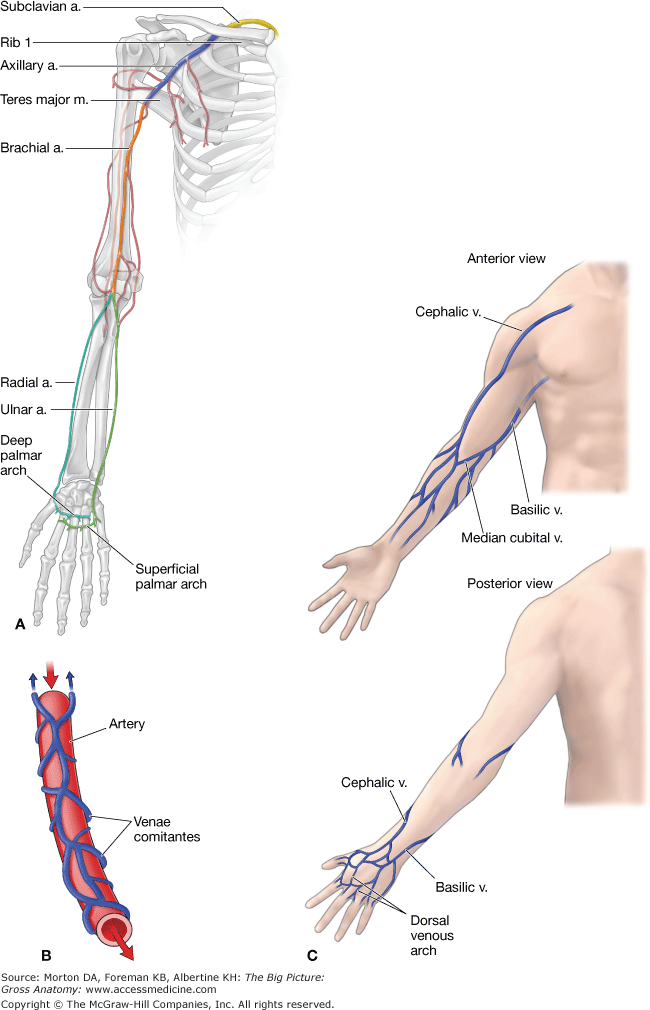
A. Arteries of the upper limb. B. Schematic of the vena comitantes around an artery. C. Superficial veins of the upper limb.
The axillary artery continues distally and becomes the brachial artery at the inferior border of the teres major muscle. The brachial artery continues distally, passing over the elbow, and bifurcates into the ulnar and radial arteries. These arteries continue into the hand, where they form the superficial and deep palmar arches.
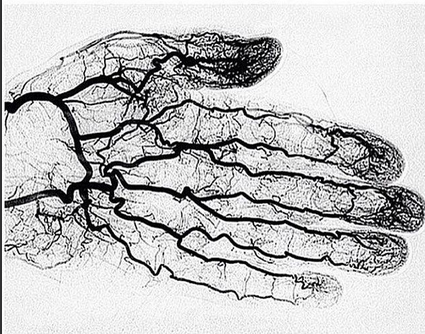
Throughout the upper limb, smaller vessels branch from the larger vessels to supply structures such as muscle, bone, and joints.
Veins
Blood is returned to the heart via a superficial and a deep venous system.
Given that the deep venous system follows the arteries, most deep veins have the same name as their accompanying arteries.
Generally, the veins of the upper limb drain into veins of the back, neck, axilla, and arm, and eventually reach the superior vena cava. The deep veins follow the arteries and usually consist of two or more veins that wrap around the accompanying artery (vena comitantes) (Figure 29-6B). The superficial veins originate in the hand and primarily consist of the basilic and cephalic veins, joined in the elbow region by the median cubital vein (Figure 29-6C).
- Basilic vein. Travels along the medial side of the arm until it reaches the inferior border of the teres major muscle, where it becomes the axillary vein.
- Cephalic vein. Runs more laterally along the arm and remains superficial until it joins the axillary vein in the shoulder. After the axillary vein crosses the lateral border of the first rib, it becomes the subclavian vein.
If you found this Site useful: